
CarbonCopy: Q3 2026 - Native forest carbon deals, LUC 6 ballot results and forest financials

News and views from CarbonCrop | Q3 2026
If you've been forwarded this newsletter, you can subscribe directly here.
EDITORIAL

With 25-35% of native forest in New Zealand on private land, farmers (for the most part) are custodians of these vital ecosystems on behalf of the New Zealand public. Most native forest that's stood on farmland since before 1990 hasn’t really had many real prospects of earning a cent in carbon revenue, despite costing farming businesses in rates, which is why the Pāmu BNZ partnership is worth keeping an eye on.
Announced in June, it covers roughly 600 hectares of established native forest on a Pāmu farm in northern Hawke's Bay, land about to be protected under a QEII National Trust covenant. The forest is mature, sequestering, with high biodiversity value - not at all an unusual occurrence on farms around New Zealand. Because it is pre-90, it’s excluded from the ETS, regardless of how much carbon it is sequestering.
Under a leasehold arrangement, BNZ takes on an operating lease over the land and counts the forest's ongoing removals - around 1,100 tonnes of CO2 equivalent a year - towards its own emissions reduction targets. Pāmu keeps managing the land under contract and reinvests the lease income into further restoration and pest control. CarbonCrop provides the measurement, monitoring and traceability behind it, so both parties can audit exactly what's being counted.
There’s still a way to go before this type of arrangement is accessible to all sizes of pre-90 native forest, but the intention is the underlying model - sequestering native forest, paired with an emissions-reduction buyer taking a long view - is replicable at a smaller scale too. If you've got native bush that's been sitting outside the ETS with no pathway to carbon revenue, keep an eye on this.
We'll be watching closely to see who follows.
CARBON MARKET COMMENTARY
From emsTradepoint
Carbon Market Overview:
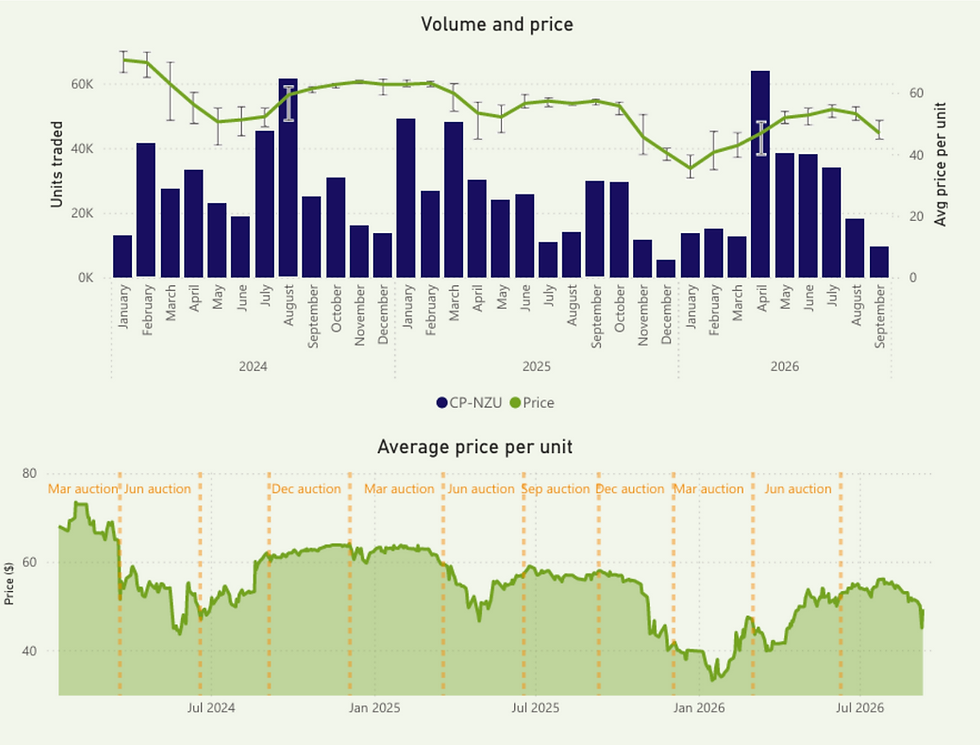
The New Zealand carbon price made a steady recovery over July and early August but struggled to get through $56.00 with any conviction. From here the price drifted lower and buyers continued to back off, this led to some seller capitulation with trades down to a low of $45.00 on emsTradepoint.
One cause of the recent sell-off is election uncertainty, with less than 2 months to the election every party is constantly making climate policy announcements into an already fragile market. The weakness in price did pique the interest of compliance buyers, at the time of writing the price had recovered to $51.00
Regulatory update:
The Government announced in August they would maintain Emissions Trading Scheme (ETS) settings largely as they are for the next five years.
The Government announced market governance reforms for the ETS that are in the Climate Change Response Amendment Bill. Initially this will mandate reporting obligations for trading platforms like emsTradepoint and a replacement unit register that is built with required functionality - no timeframe given.
NZU Auctions:
The auctions continue to be a non-event, no bids in March, June nor September, in fact the September auction was the 7th consecutive fail. All available units will be rolled over for the next auction on 1st December 2026.
International Carbon Markets:
EU carbon prices have traded in a 78 Euro - 88 Euro range over the last 3 months, currently sitting near the top end of that range.
Australian units (ACCU’s) at $37.55 AUD ($46.50 NZD).
LUC 6 BALLOT
100% success for our customers
MPI has now confirmed the official results: just 14 of 105 applications drawn nationally, covering just under 6,000 hectares. Large applications had it toughest, with only 3 of 58 drawn - about 5%. Our customers landed in both categories and picked up roughly 3,500 of those hectares between them.
The next ballot is still free to enter (that changes from January 2027), so if you're thinking about registering exotics on LUC class 6 land, get in touch and we'll help you apply.
PLATFORM UPDATES
Forest Financials: NPV, IRR and payback period
Until now, you could see what a forest might earn in carbon revenue - but not what it costs to establish, or when it actually pays for itself. That gap's closed. You can now see the full financial picture for any site or polygon: net present value (NPV), internal rate of return (IRR) and payback period, sitting right alongside the carbon income projections you already know.
The new chart shows net carbon income and establishment costs side by side, with a cumulative discounted cash flow line so you can see exactly when a project breaks even. Hover over NPV, IRR or payback period and you'll get a plain-English explanation of what each one means - no finance degree required. One thing to know: the discount rate is currently fixed at 7%, with an adjustable option planned for a future update.

Also recently shipped: Custom Layers and Usability Improvements (September 2026)
A batch of smaller wins this month, including custom layer colours that now stick between sessions, a tags filter on the Sites Map, and ballot application status tracking built directly into Carbon Intelligence - handy if you're waiting to hear back on an LUC 6 ballot entry. Read more.
See all recent platform updates here.
CASE STUDY
From plan to planted: erosion control that actually happens
A steep, slipping 4.7-hectare block on a Hawke's Bay hill country farm had been sitting on the erosion-control wish list for years - the kind of job that's easy to let slide when nobody's keeping it moving. Huiarau, a member farm of the Puketoi to Pacific Catchment Collective (PPCC), turned that around this winter.
PPCC used the CarbonCrop platform to map the property and rough out a planting plan first, then brought in Horizons land management advisor Courtney Skou to check it against her expertise - the right species and pole length for a windy site, and how it fitted the Hill Country Erosion Fund. Because the plan was already mapped on the platform, Skou didn't need a site visit to sign off on the funding.
Over the school holidays, the family put 275 poles into the ground, working row by row down the slope. It's a test case, and PPCC is already planning similar conversations with more farmers across the catchment this spring and summer.
THINGS YOU MIGHT HAVE MISSED
From CarbonCrop
The evidence gap in landscape-scale restoration Why proving restoration works at scale is harder than it sounds - and what better evidence could unlock.
Buying or selling a property with ETS-registered forest? A two-part explainer on what changes hands, and what has to happen, when ETS-registered forest land changes ownership. See also: Selling a property with ETS-registered forest (companion piece).
New fees and charges in the NZ ETS: what you need to know Updated in August to cover the 1 September land status notice fee alongside the July annual charge changes - see Important Dates below for the specifics.
From further afield
Government backs growth of trusted voluntary nature and carbon markets Beehive release on the government's plan to accredit voluntary nature and carbon credit schemes - direct context for the case study above.
Voluntary carbon and nature markets bodies endorsed by NZ govt (RNZ) A more digestible read of the same announcement for a general audience.
Adrift: what future does the Emissions Trading Scheme have? (PCE) The Parliamentary Commissioner for the Environment's report on the ETS's structural future - credible, timely background for readers navigating scheme uncertainty.
Kaimai-Mamaku breaks new ground with nature credits (Farmers Weekly) Manaaki Kaimai Mamaku Trust is close to confirming its first nature credit buyer, via UK-based CreditNature - an early, concrete NZ example of nature credit schemes moving from concept to transaction.
IMPORTANT DATES
1 Sept 2026: New MPI fee of $330 (+GST) now applies for adding or removing a land status notice, when land is newly registered in, or fully deregistered from, the ETS. More here.
8 Sept 2026: NZ ETS Q3 auction took place under new operator Xpansiv - the first since the switch. Results due shortly. More here.
Now due: Annual ETS charge invoices for the 2026-2027 financial year have gone out - pay MPI directly. The per-hectare rate has dropped from $14.90 to $10.28 following this year's fee consultation. More here.
1 Dec 2026: NZ ETS Q4 auction. More here.
LUC 6 second ballot: Opens before 31 December - exact date TBC, MPI will give at least 10 working days' notice. More here.
If you found this helpful, please feel free to forward it to others. They can subscribe here to receive the newsletter directly.


Comments